The familiar metal case. The hinged lid. The protected flame. All part of an American design legend — but the story begins with an Austrian lighter.
A spark in Bradford
An unexpected beginning
Some inventions begin with a completely new discovery. Others begin with someone looking at an everyday object and asking a deceptively simple question: Could this be made better?
The story of the Zippo lighter belongs to the second group.
Today, a Zippo is easy to recognize. There is the familiar metal case, the hinged lid, the sound it makes when opened, and the little chimney protecting its flame. These details have become closely associated with American design. Yet the inspiration behind the original Zippo came from a lighter made in Austria.
Long before George Grant Blaisdell began producing his own pocket lighters in Bradford, Pennsylvania, Austrian makers were experimenting with petrol lighters designed to work outdoors. Among the historical examples collectors study today are lighters described as the MEB Hurricane, as well as other Austrian windproof designs sold under names such as Cyklon and Cyclone.
One important detail deserves to be clear from the start: the Austrian origin of Blaisdell's inspiration is well documented, but the exact make and model of the lighter he saw have not been conclusively identified. The MEB Hurricane is part of this fascinating history. It should not, however, be presented as the proven, one-and-only lighter Blaisdell held in his hands.
In fact, the uncertainty is part of what makes the story so interesting. To understand where Zippo came from, we need to look at the people, the technology, and the world in which that little Austrian lighter was made.
George G. Blaisdell: a practical mind from Bradford
George Grant Blaisdell was born on June 5, 1895, in Bradford, Pennsylvania. Bradford was an important American oil-industry town, and mechanical work was a familiar part of everyday life there.
His father was involved in the machinery business. As a young man, George gained practical experience with tools and metalworking, learning to appreciate how mechanical objects were designed and manufactured. That background would later help him understand both the strengths and the weaknesses of the lighter that caught his attention.
Blaisdell was involved in business ventures, including the oil industry, before establishing Zippo. Then came the Great Depression. The economic crisis that followed the stock market crash of 1929 created difficult conditions for businesses across the United States. Starting something new in 1932 was hardly a risk-free decision.
And yet the idea that would define Blaisdell's career did not come from oil drilling, a factory machine, or some elaborate laboratory experiment. According to the familiar Zippo origin story, it came from watching someone light a cigarette.
The Bradford Country Club encounter
The scene most closely associated with Zippo's beginnings is the Bradford Country Club in the early 1930s.
Blaisdell noticed a friend using an awkward-looking Austrian lighter. It was practical rather than elegant. Its thin metal construction could be dented, and the separate cover made it inconvenient to operate. Lighting it generally required two hands.
But the lighter had an advantage that was hard to ignore. Its flame was protected by a specially shaped metal wind guard, so it worked surprisingly well even in breezy conditions.
The best-known version of the story says that Blaisdell asked his friend why he did not use a more attractive lighter. His friend supposedly answered, 'Well, George, it works!'
That line has been repeated for decades. It captures the spirit of the story, although we cannot establish that those were the precise words spoken in the room.
What matters is the observation behind it. Blaisdell saw a lighter whose basic function was excellent but whose shape and handling could be improved. Instead of dismissing the Austrian device as clumsy, he recognized the clever engineering hidden inside it.
This was the beginning of an idea: keep the wind-resistant flame, but give the lighter a stronger, more attractive case and a lid that could be opened and closed with one hand.
The Austrian connection
Austria before Zippo: a world of clever little lighters
The Austrian lighter industry had been developing distinctive mechanical designs long before Zippo was founded. Vienna and other manufacturing centers were home to makers who experimented with pocket lighters, flint mechanisms, fuel reservoirs, removable covers, and different ways to shield a flame.
A typical petrol lighter of this period used a flint wheel to produce sparks. Those sparks ignited a wick fed by lighter fluid held in absorbent material inside the body. The idea was not unique to Zippo, nor did Blaisdell invent the flint wheel or the petrol-soaked wick.
One especially useful development was the wind guard. A completely exposed flame can be extinguished by a sudden gust. Put a metal chimney around the wick, add openings to admit air, and the flame becomes less vulnerable to direct wind.
This does not make any lighter completely windproof. Every flame has limits. But it greatly improves how reliably a wick lighter can be used outdoors.
These Austrian designs were ingenious in their own right. They were not simply unfinished versions of the Zippo. They belonged to an established tradition of solving practical problems through compact mechanical design.
The MEB Hurricane and the question of its identity
For collectors, the name MEB Hurricane brings the Austrian side of the story into focus. It is associated with an early style of wind-resistant petrol lighter that helps explain why Blaisdell was attracted to European designs in the first place.
The letters MEB refer to M. E. Bernhardt Co. of New York, a business known for importing and distributing lighters, including Austrian-made models. Surviving catalog material and collector research show that MEB handled a range of imported products. Therefore, an MEB marking is not, by itself, proof that a lighter was manufactured by a company called MEB in Austria.
This distinction matters because early lighters could carry several kinds of identification: a maker's mark, an importer's name, a trade name, a patent reference, or a combination of these. The name on the outside does not always tell the whole story of who designed or manufactured the object.
Austrian windproof lighters are also encountered under names such as Cyklon, Cyclone, Hurricane, and Taifun. These names do not necessarily identify one single manufacturer or one identical construction. Designs could be related, advertised under different names, or distributed in different markets.
One often-repeated account attributes a Hurricane or 'Hurricane Cyklon' to the Viennese firm Gebrüder Simon. That attribution has been questioned by researchers of historical Austrian trade directories, and it remains insufficiently established to name the company as the definite maker of Blaisdell's original inspiration.
There is an important difference between a well-known story and a documented identification. Zippo's own historical account confirms that Blaisdell saw an Austrian-made lighter with a wind-protecting chimney. It does not identify that lighter by the name MEB Hurricane, nor does it establish a particular Austrian manufacturer.
The strongest conclusion is therefore also the fairest: the MEB Hurricane belongs in the story as a real historical example of the kind of Austrian lighter technology that preceded Zippo. Whether Blaisdell encountered that exact model remains an open question.
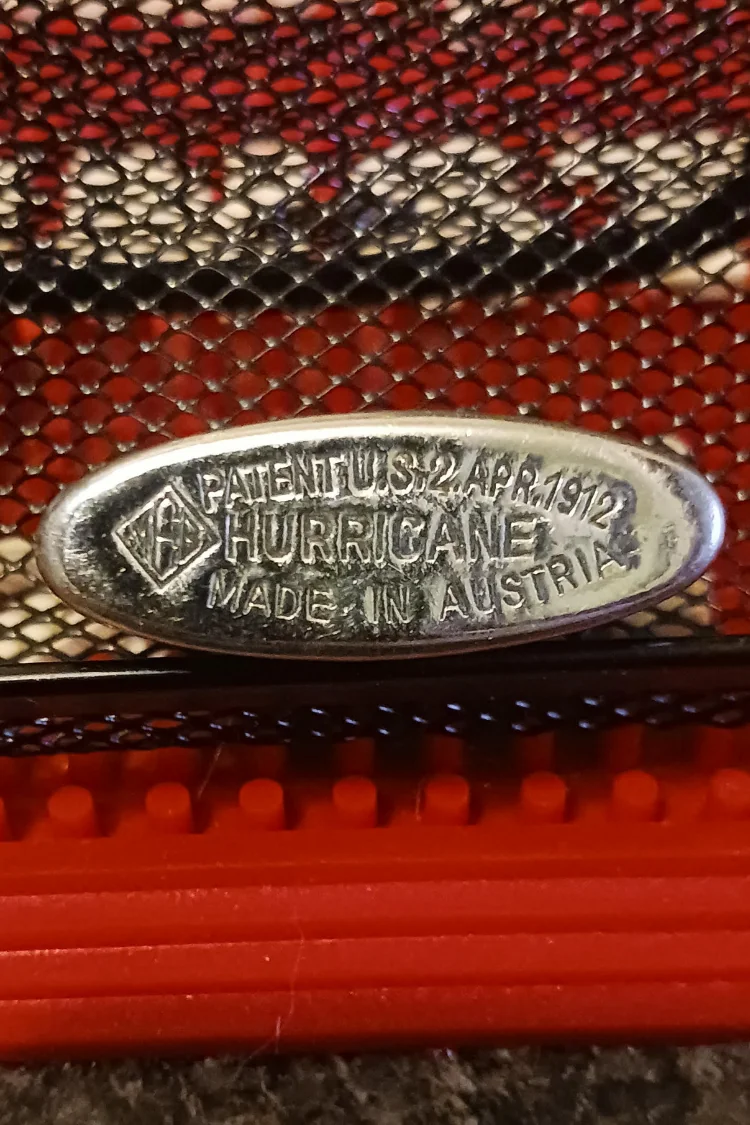
That does not reduce its historical appeal. If anything, it gives collectors another reason to examine original examples closely, especially their construction, patent markings, logos, and differences from other surviving Austrian models.
How the wind guard changed everything
The mechanical principle deserves a closer look, because it is central to this entire story.
In a wick lighter, fuel rises from the reservoir through the wick. Turning the toothed ignition wheel against a flint creates sparks, some of which ignite the fuel vapor around the exposed end of the wick.
If the flame sits completely unprotected, wind can push it away from the fuel vapor and extinguish it. A perforated metal chimney helps by shielding the base of the flame while still allowing air to enter through the openings.
It is a balancing act. A lighter needs oxygen for combustion but also needs protection from strong air movement. The shape and location of the holes are therefore functional parts of the design, not merely decoration.
Blaisdell's innovation was not to discover this principle. It was to incorporate it into a pocket lighter that was easier to operate and more robust in everyday use.
The same broad principle can still be recognized in the familiar Zippo chimney today.
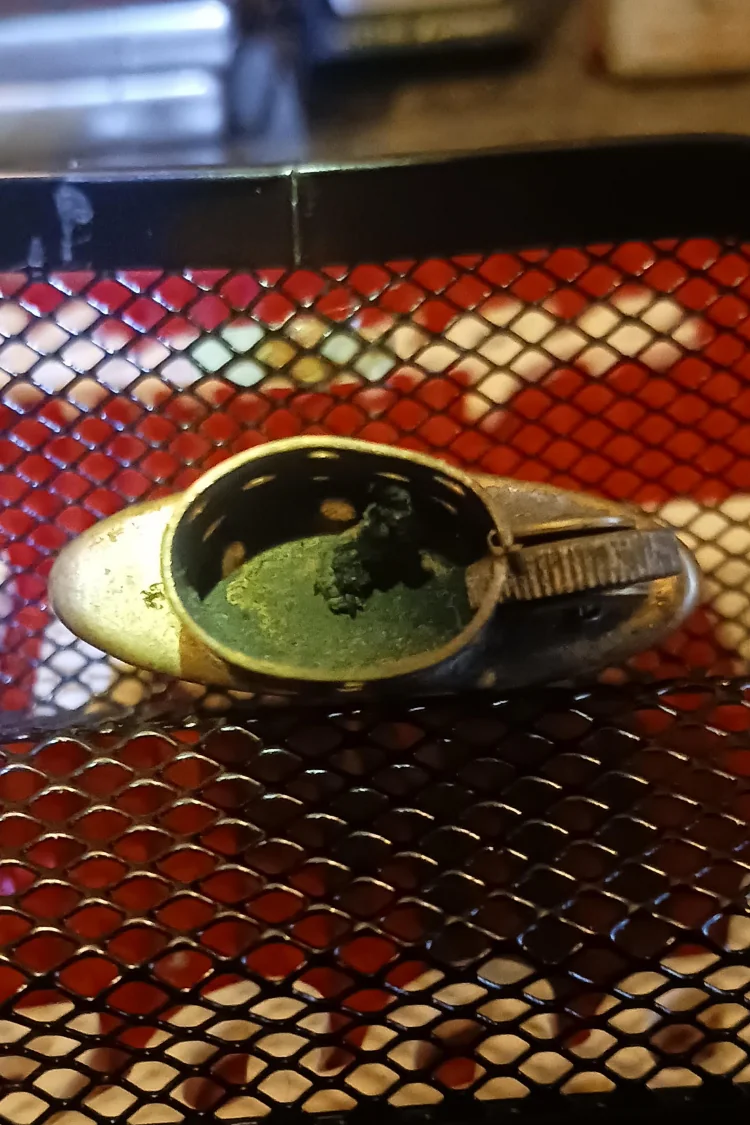
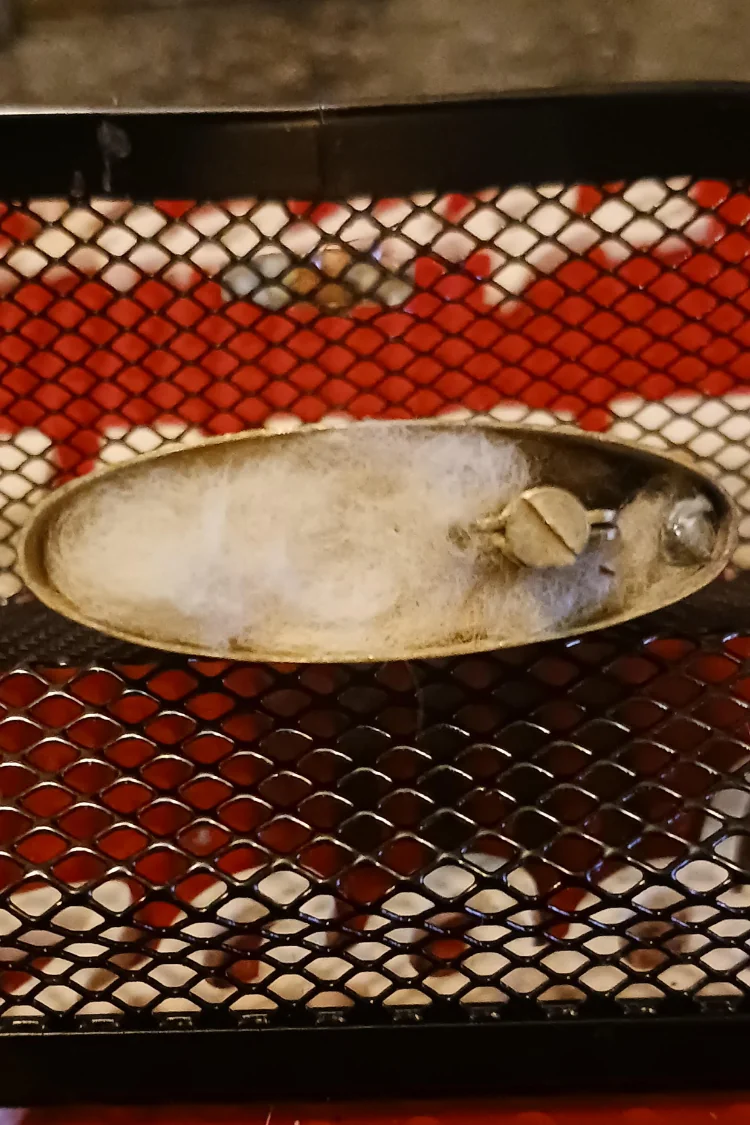
The original MEB Hurricane · a photographic study
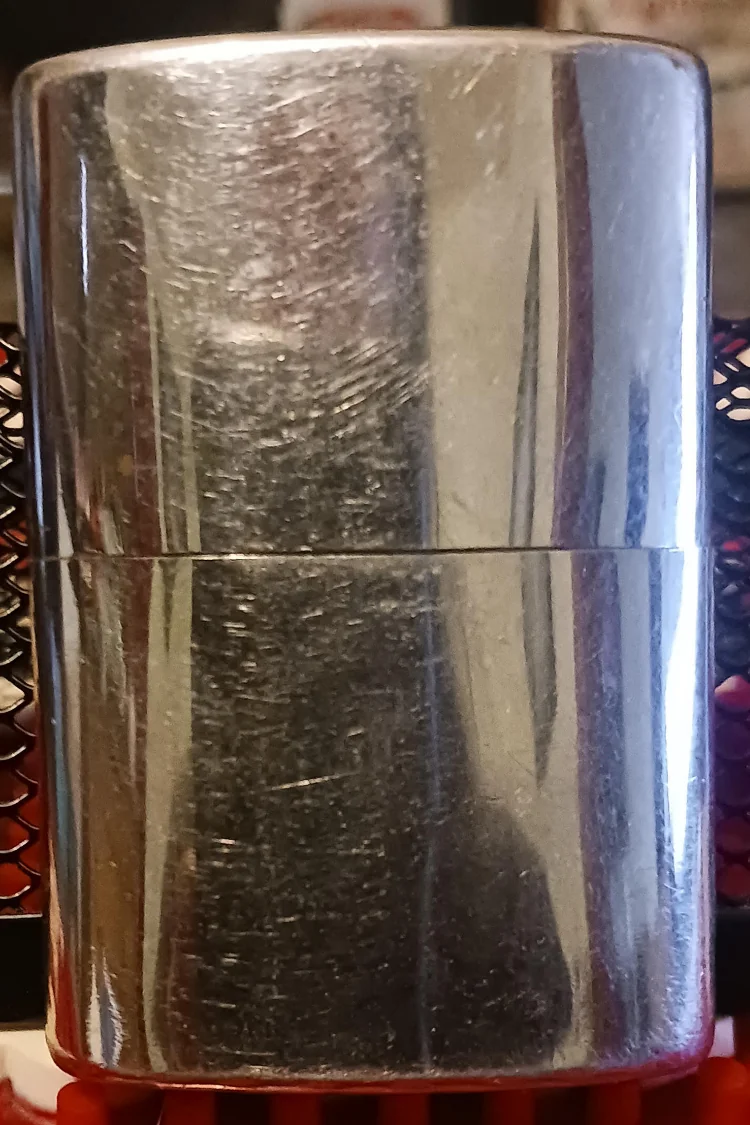
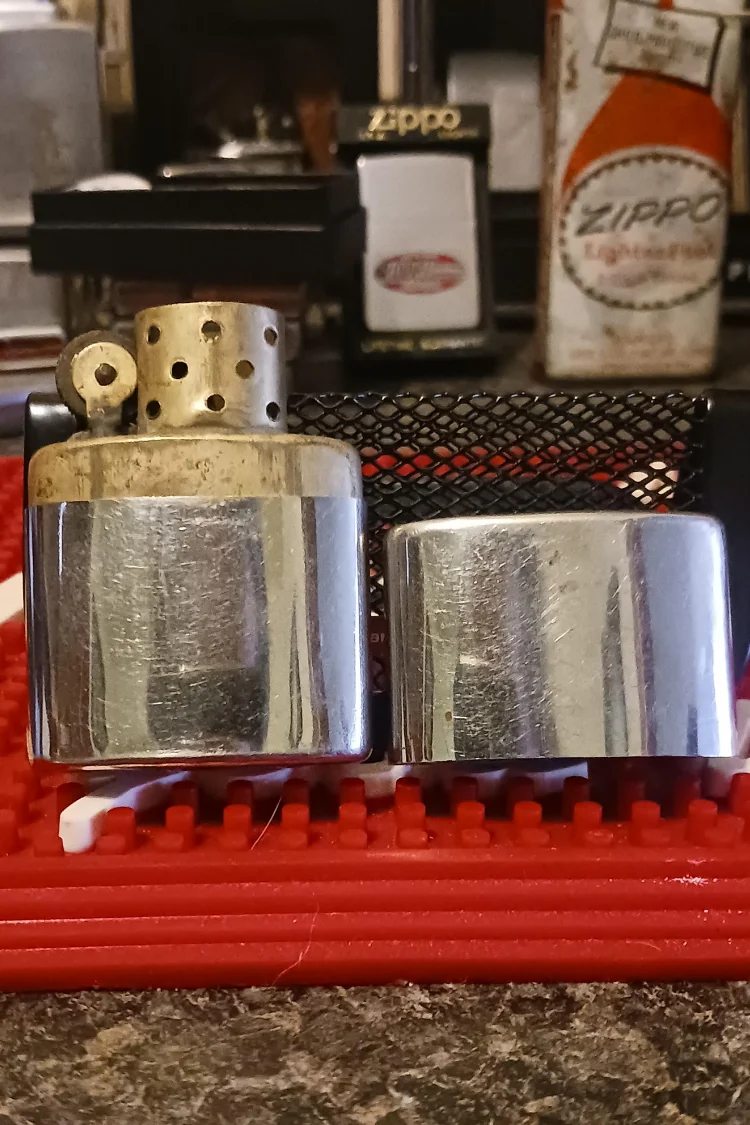
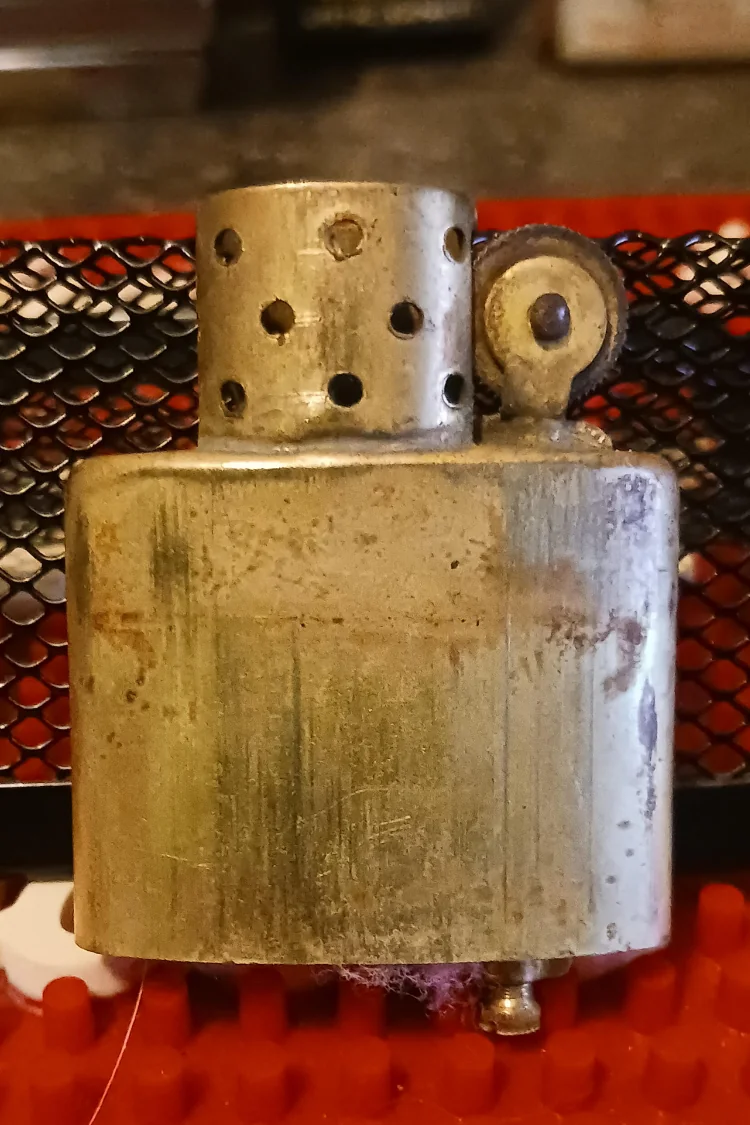
Five close-up views of the same historic lighter. Select any image to examine the original photograph at full resolution. No source pixels have been altered.
Building the first Zippo
From an Austrian lighter to an American business idea
Later accounts say Blaisdell first explored selling the Austrian lighter in the United States, sometimes describing an arrangement involving American distribution rights. The basic story is widely repeated, but the precise contractual details are not established by the surviving documents available for this account.
In those retellings, the attempt was not a commercial success. Potential customers could appreciate the wind-resistant flame without necessarily wanting the awkward detachable cover and utilitarian appearance.
Whether every detail of that first business attempt is recoverable or not, the direction of Blaisdell's eventual work is clear. Rather than merely copying the imported product, he rebuilt the concept around a new case and a simpler method of operation.
The practical question became: how do you keep everything that works and remove what gets in the way?
1932: the company and the idea
The Zippo Manufacturing Company was established in Bradford in 1932. Accounts of its beginnings describe an initial investment of about $800, an impressive reminder of how modest the operation was compared with the company that followed.
In late 1932, Blaisdell was working on the design that would become the Zippo pocket lighter. He replaced the Austrian lighter's separate cover with a hinged lid attached to a sturdy, rectangular metal case.
This was more than a visual change. With a lid connected to the case, the user no longer had to remove and hold a loose cap. The lighter could be opened and used with one hand. A mechanism helped keep the lid in position, while a removable inner unit contained the fuel reservoir, wick, flint, and ignition wheel.
The wind-protecting chimney remained a central feature, but the new case and operating mechanism made the complete product distinctly different from the Austrian lighter.
This point is worth emphasizing: Zippo's first lighter was not simply an Austrian model with a new logo. Blaisdell and those working with him developed a new mechanical arrangement that combined existing ignition technology with a distinctive case and lid.
1933: the first Zippo lighters are made
Although the company was founded in 1932, the first Zippo lighters were actually manufactured in January 1933.
This is not just a modern guess. It was confirmed when historical material from the Blaisdell family was examined decades later, and it is explained in Zippo's own published company history.
The earliest Zippo was taller and more angular than the familiar modern version. Its case and inner unit were made using sections of brass tubing. Separate top and bottom pieces were soldered into place, giving the case its straight walls and square corners. The working hinge was attached to the outside of the case.
An official historical account describes these earliest examples as about a quarter of an inch, or roughly 6.4 millimeters, taller than the later standard lighter. Some had plain cases, while others carried decorative lines at the corners.
The first production effort was very small. According to figures published by Zippo's archivist, 82 lighters were made during January 1933, and the company recorded a profit of $62.15 that month.
Those are wonderful numbers to remember. It is difficult to imagine a stronger contrast: 82 lighters and a little over sixty dollars in profit at the start, followed decades later by hundreds of millions of lighters produced.
A separate historical business account reports that approximately 1,100 Zippos were sold in their first production year. This is a sales figure, not proof of the number of examples of any particular early case variation made.
The original lighter sold for $1.95. In the middle of the Great Depression, Blaisdell needed customers to believe they were buying something worth keeping. Reliability, repairability, and the company's promise to stand behind the product were therefore central to the sales pitch.
A room above a garage
The first Zippo operation was a long way from the large manufacturing facilities many people associate with the name today.
Blaisdell began with a modest workshop above the Rickerson & Pryde garage in Bradford. An early business history describes a room rented for just ten dollars a month, a small amount of equipment, and a tiny workforce.
There is something appealing about this detail. One of the world's most recognizable industrial products began not in a vast factory but in a small rented space where a few people had to make every improvement count.
The early construction was also relatively labor-intensive. Cutting brass tubing, joining the case components, and attaching the outside hinge required a different approach from the manufacturing methods that would later become standard.
Zippo continued improving the lighter in the years that followed. The design was not frozen in 1933. Changes to case proportions, hinges, and production techniques gradually transformed the tall, square-cornered original into the more familiar shape.
By 1937, the development of a drawn brass case with rounded edges allowed a different, more efficient style of manufacturing and reduced the need for the older soldered case construction.
Where did the name “Zippo” come from?
The name has a story of its own.
Blaisdell liked the sound of the word 'zipper'. The zipper was an increasingly familiar example of modern practical engineering, and its short, lively name appealed to him.
He experimented with variations until he settled on 'Zippo', a word he felt sounded modern.
This leads to a fun misconception. It is tempting to think that the name must come from the distinctive metallic sound made when the lighter opens. But the company explains the name through 'zipper', not through the noise of the lid.
The click later became famous in its own right. Over time, a mechanical sound associated with opening and closing a case became part of the identity of the brand itself.
A guarantee that became part of the product
From the beginning, Blaisdell wanted customers to see a Zippo as a dependable object, not something to be discarded as soon as it developed a fault.
The company's famous promise was simple: 'It works or we fix it free.'
It expressed a philosophy that made good commercial sense. A lighter designed for regular use would need fuel, flints, and occasional maintenance. Mechanical parts might eventually wear. The manufacturer promised to repair the windproof lighter rather than expect the owner to throw it away.
The guarantee helped distinguish Zippo from many competing products. It also helped turn the lighter into an object that could remain with one owner for decades, or even be passed on to someone else.
The promise is an important part of Zippo history, although service terms and their legal treatment can vary by country and type of product. It should not be mistaken for a guarantee that consumables never need replacing or that every form of cosmetic wear is covered.
One original patent, two named inventors
An especially interesting detail can be found in the original United States patent.
The application was filed on May 17, 1934. On March 3, 1936, U.S. Patent No. 2,032,695 was granted for a 'Pocket Lighter'.
Most people associate the invention with George G. Blaisdell, but he was not the only inventor named on this patent. It also identifies George Gimera.
The patent is particularly revealing because it concerns the lighter's practical operating mechanism, including the hinged cover and the means of keeping it in position. Its purpose was not simply to claim the general idea of a flame protected from wind.
The original document also lists additional individuals as members of the partnership to which the invention was assigned. That detail is a reminder that even a product so strongly identified with one founder has a wider human and engineering history.
Another useful collector detail follows from the dates. The first Zippos were sold in 1933, before this patent was granted. A patent number granted in 1936 should not be expected on an original lighter manufactured three years earlier.
The making of an American icon
The first advertising Zippos
An important step came in the mid-1930s when the Kendall Refining Company of Bradford ordered 500 lighters bearing company advertising.
Zippo identifies these as the earliest known examples of its company-advertised lighters.
That order changed the possibilities for the small metal case. A Zippo could do its everyday job and also carry a company name, a message, or a design that stayed with its owner.
From there, the business of advertising lighters developed into a major part of the Zippo story. Much of the variety that fascinates modern collectors grew out of this simple realization: a useful object can also be a lasting reminder of a person, a business, or an event.
World War II and the Black Crackle lighter
The Second World War brought a dramatic change. After the United States entered the war in December 1941, Zippo devoted its lighter production to the U.S. military rather than civilian customers.
With brass needed for wartime production, steel cases became an important part of the company's wartime manufacture. The familiar rough black protective coating is now known to collectors as 'Black Crackle'.
The wartime lighters were not just tools. They accompanied service personnel through difficult experiences and sometimes carried engraved names, places, or personal messages. Surviving examples can be extraordinary historical objects, although any claimed wartime provenance should be evaluated carefully.
In Zippo's later company timeline, 1942 is also identified as the year the lighter made its first major film appearance. It was an early sign that the little pocket object would become part of a much larger cultural story.
Military production helped make Zippo internationally familiar and contributed to the company's ability to survive and grow. When civilian sales resumed after the war in 1945, the name already carried a reputation far beyond Bradford.
There is a remarkable connection here to the original Austrian idea. A wind-protecting chimney had first attracted Blaisdell's attention because it made a lighter work under difficult conditions. During the war, that same basic advantage became a major part of the Zippo's reputation.
1947: the car that looked like a lighter
George Blaisdell also understood the value of memorable advertising.
In 1947, Zippo introduced the legendary Zippo Car, an extraordinary promotional vehicle designed to carry oversized representations of the company's lighter. It was intended to attract attention wherever it traveled.
The idea was as unconventional as it was effective. An everyday pocket object had become recognizable enough that it could be enlarged to the size of a vehicle and still be instantly understood.
The Zippo Car is now one of the best-loved stories in the company's advertising history.
The design keeps evolving
Zippo continued refining the lighter without abandoning the basic idea.
A second U.S. patent, No. 2,517,191, was issued on August 1, 1950. The company's changes to case construction, hinge design, and internal mechanisms were part of a long process of making the product easier to manufacture and dependable to use.
During the mid-1950s, Zippo began putting date codes on its lighter cases. They were introduced for quality control, but collectors now use them to help identify production periods.
For the earliest Zippos, however, dating is more complicated. A 1933 or 1934 example does not have a modern month-and-year code waiting to be read. Collectors must study details such as its construction, bottom stamp, patent markings, hinge, and insert. Those features can provide evidence, but isolated features do not always settle every question.
In 1956, Zippo introduced the Slim, a narrower version of the classic lighter. It was originally intended to appeal particularly to women, but found admirers among men too.
The fact that the standard lighter and the Slim both remained recognizable descendants of Blaisdell's original idea shows how flexible the basic concept had become.
The company also started exploring products beyond lighters. In 1962, Zippo introduced its first non-lighter product: a small steel pocket tape measure, sometimes called a 'rule'. It was another way to bring the recognizable Zippo style into everyday life.
The Zippo Moment: from pocket to pop culture
During the 1960s, audiences at concerts began holding lit lighters in the air to salute or encourage performers. The gesture later became widely known as the 'Zippo Moment'.
For generations, the sight of small flames moving above a crowd became part of live-music culture. It is a striking example of an everyday object acquiring a meaning far beyond its original purpose.
By then, Zippo had become more than a practical lighter. It was a recognizable prop in movies, a canvas for artistic designs, and a personal object carried through moments both ordinary and extraordinary.
There is also a technical twist to this cultural history. The distinctive metallic click was once merely the sound of the lid mechanism doing its work. In 2018, Zippo registered the familiar opening-and-closing sound as a trademark, recognizing something collectors had known for years: the sound itself had become part of the brand.
1978: the end of the founder’s life, not the story
George G. Blaisdell died in October 1978. Zippo's official company chronology gives October 3 as the date.
By then, the business that had started in a room above a garage had grown into an international brand. His daughters, Harriett B. Wick and Sarah B. Dorn, inherited the company.
What survived him was not just a product. It was a particular approach to design: make a useful thing simple to operate, strong enough to last, and practical to repair.
The people who developed and manufactured Zippo lighters over the decades played an enormous role in keeping that idea alive.
Rediscovering the history
1997: the family box that corrected Zippo history
One of the most remarkable later chapters brings us back to the question of when the first Zippo was actually made.
For years, the first Zippo was commonly described as a '1932 lighter'. That was understandable: the company had been founded in 1932, and early retellings often blended the company's founding year with the beginning of lighter production.
In 1997, while preparations were under way for the museum at the new Zippo/Case Visitors Center, Blaisdell's daughter Sarah Dorn brought in a box that had been stored at her home.
The historical material helped establish the distinction conclusively. Zippo was founded in October 1932, but the first lighter was made in January 1933.
The story was later told by Zippo archivist Linda Meabon in the inaugural 2002 issue of the company's collector publication, The Zippo Click.
It also explains a curious episode in Zippo collecting. The original-style lighter was re-created as the 'Original 1932 Replica' from 1988 to 1992, and the name returned for a short-lived Second Release in 1997. Following the correction of the historical date, Zippo introduced the '1933 Replica' in 1998. That version remained in production through 2001. The names are a small but memorable record of how the company's understanding of its own early chronology changed.
One of the first lighters was accompanied by a handwritten instruction from Blaisdell identifying it as the first Zippo and warning others not to touch it.
The discovery had a practical consequence for collectors. Zippo had already produced a modern reproduction known as the Original 1932 Replica. After the historical correction, the early design was also presented under the more accurate name 1933 Replica.
So a small box kept within the founder's family helped correct a familiar part of the brand's own history more than sixty years after production began.
It is hard to imagine a better reminder of why original objects, documents, and careful research matter.
The original lighter in Bradford
The first Zippo lighter from 1933 is preserved in the Zippo/Case Museum in Bradford, Pennsylvania. The Visitors Center opened in July 1997. The shared Zippo/Case name reflects another chapter of the company's history: Zippo acquired the knife manufacturer W. R. Case & Sons in 1993.
This is more than a display of a rare old lighter. It allows visitors to see how different the first model was from the more rounded standard Zippo that followed.
Its square corners, tall body, soldered construction, and external hinge tell a story that a modern logo alone never could. They show the moment when Blaisdell's new concept was still very close to its workshop origins.
The museum is also an appropriate place for the corrected 1933 date to be remembered. It was preparations for this institution that brought some of the decisive early documents back into view.
How a modest start became a manufacturing milestone
The scale of Zippo's later success is almost difficult to take in when compared with those first 82 lighters made in January 1933.
In 2012, during the company's 80th anniversary year, Zippo celebrated production of its 500 millionth windproof lighter.
On June 3, 2020, the company produced its 600 millionth lighter. Zippo marked the milestone with a special commemorative design and preserved the historic lighter for display in Bradford.
These figures are not necessary to understand how a wick and a wind guard work. But they underline how far the idea traveled: from a small Austrian lighter that worked in the wind, to a workshop in Pennsylvania, to hundreds of millions of American-made pocket lighters.
The numbers are also a reminder that a product can be both ordinary and extraordinary. Millions of people have used Zippos as practical tools; others have treasured them as gifts, memories, or collectibles.
A collector’s perspective
What makes an old Austrian lighter special to a collector?
An original MEB-marked Austrian lighter deserves attention in its own right, not merely because of its connection to Zippo.
Its case shape, cap, flint-wheel mechanism, fuel arrangement, chimney, and wear patterns all show how a maker approached problems of reliability and convenience before the famous American design appeared.
Collectors can learn a great deal by examining the markings carefully. 'Made in Austria' can help establish a country of manufacture. A name or logo may refer to an importer rather than the maker. A patent number may concern only one part of the mechanism, not the complete lighter. A trade name may describe a sales line used in a particular country.
The best comparison is physical rather than purely romantic. Does the Austrian lighter have a separate cap? How does the wheel operate? Where is the wick positioned? How does air reach the flame? Which components are removable? What does it take to refill or service it?
Placed beside a classic Zippo, the differences help explain Blaisdell's achievement. The older European design demonstrates the windproofing idea. The American lighter adds a hinged case and a distinctive approach to one-handed operation.
An original MEB Hurricane is part of the ZippoCollector.com collection. Its surviving details offer an opportunity to explore the Austrian side of the story through a real historical object rather than relying entirely on illustrations or secondhand descriptions.
It is important, however, not to claim that an original specimen in any modern collection has been proved to be the exact model Blaisdell encountered. Until a reliable contemporary identification appears, that question remains open.
A few myths worth clearing up
- Was Zippo invented in 1932 or 1933?
- The company was founded and the design was developed in 1932. The first Zippo lighters were manufactured in January 1933. Both dates matter, but they refer to different events.
- Did Blaisdell invent the windproof petrol lighter?
- No. Petrol lighters, flint wheels, wicks, and wind guards already existed. His achievement was combining proven ideas in a more convenient and distinctive construction.
- Was the MEB Hurricane definitely the lighter he saw?
- No conclusive identification has been found. The Austrian origin is well established; the precise model and its manufacturer are not.
- Does MEB identify the Austrian manufacturer?
- Not necessarily. M. E. Bernhardt was an American importer and distributor associated with Austrian and other European lighters.
- Are Zippo lighters completely impossible to blow out?
- No. The chimney improves resistance to wind, but no ordinary open flame is immune to every condition.
- Did the word 'Zippo' come from the click?
- No. The official explanation links it to Blaisdell's liking for the word 'zipper'. The famous click became an identifying feature later.
- Was the first Zippo shaped exactly like a modern one?
- No. The original 1933 model was taller, squarer, made from brass tubing with soldered pieces, and had a genuine externally mounted hinge.
Key dates in the story
- 1895George Grant Blaisdell is born on June 5 in Bradford, Pennsylvania.
- 1929The economic crisis that became the Great Depression begins.
- 1932Zippo Manufacturing Company is founded; Blaisdell develops his new lighter design.
- January 1933The first Zippos are manufactured; the first month's output is recorded as 82 lighters.
- 1933The new Zippo reaches customers at a selling price of $1.95.
- May 17, 1934Patent application for the early Zippo mechanism is filed.
- Mid-1930sKendall Refining Company orders 500 advertising lighters.
- March 3, 1936U.S. Patent No. 2,032,695 is granted to George Gimera and George G. Blaisdell.
- 1937Rounded, drawn-brass case construction begins to replace the earlier angular method.
- 1941–1945Zippo focuses on wartime production for the U.S. military; steel Black Crackle cases become a hallmark of the period.
- 1947The famous Zippo Car appears.
- August 1, 1950A second Zippo patent, No. 2,517,191, is issued.
- Mid-1950sDate coding becomes part of Zippo production.
- 1956The Zippo Slim is introduced.
- 1960sThe 'Zippo Moment' becomes part of concert culture.
- 1962Zippo introduces its first non-lighter product, a steel pocket tape measure.
- October 1978George G. Blaisdell dies.
- 1993Zippo acquires W. R. Case & Sons Cutlery Company.
- 1997Historical material brought in by Sarah Dorn confirms that the first Zippo was manufactured in 1933, not 1932; the Zippo/Case Visitors Center opens.
- 2002Zippo documents the 1933 discovery in its collector publication and obtains trademark registration for the lighter's case shape.
- 2012Production reaches 500 million windproof lighters.
- 2018The recognizable Zippo click receives sound-trademark protection.
- June 3, 2020Zippo produces its 600 millionth lighter.
An Austrian idea, an American legend
Pick up a Zippo today and you may think of Bradford, the famous guarantee, the solid metal case, or the unmistakable sound of its lid. Those are all genuine parts of the story.
But its beginnings also belong to a much wider history of European lighter making. Austrian designers had already learned how to protect a wick flame from the wind. Importers carried such designs across the Atlantic. And in Pennsylvania, George G. Blaisdell recognized that a clever mechanism could become an even better everyday product if it were given a different case and a more convenient way to operate it.
The MEB Hurricane is a fascinating way to explore that earlier chapter. It represents the craftsmanship, experimentation, and international trade that formed the background to Zippo's creation, even though the precise identity of Blaisdell's Austrian lighter remains unproven.
Perhaps that is the most interesting lesson in the whole story. Great products rarely appear out of nowhere. They grow from earlier ideas, other people's work, practical observations, and the determination to improve something that already works.
In 1932, Blaisdell recognized an opportunity. In 1933, the first Zippo lighters were made. Decades later, that simple design had become an industrial and cultural icon.
An Austrian inspiration. An American invention. And a story that continues every time a Zippo lid clicks open.